Late night thoughts on TFUEL, the utility token
- TFUEL
- EdgeCloud
- Builder Log
- Notes

A few days ago I quietly noticed something about my chatbot.
I had not paid for it.
Not in the sense that it was free — running an AI agent costs real compute, real GPU time, real electricity somewhere. Someone is paying. It just was not me. Not in fiat, anyway.
What I had done was this: at some point, I bought TFUEL. I staked it. The stake earned more TFUEL — the standard validator-and-elite-edge rewards Theta has been running for years. I sent a small amount of that earned TFUEL into my Theta EdgeCloud billing balance. And then I started running the chatbot on the site against that balance.
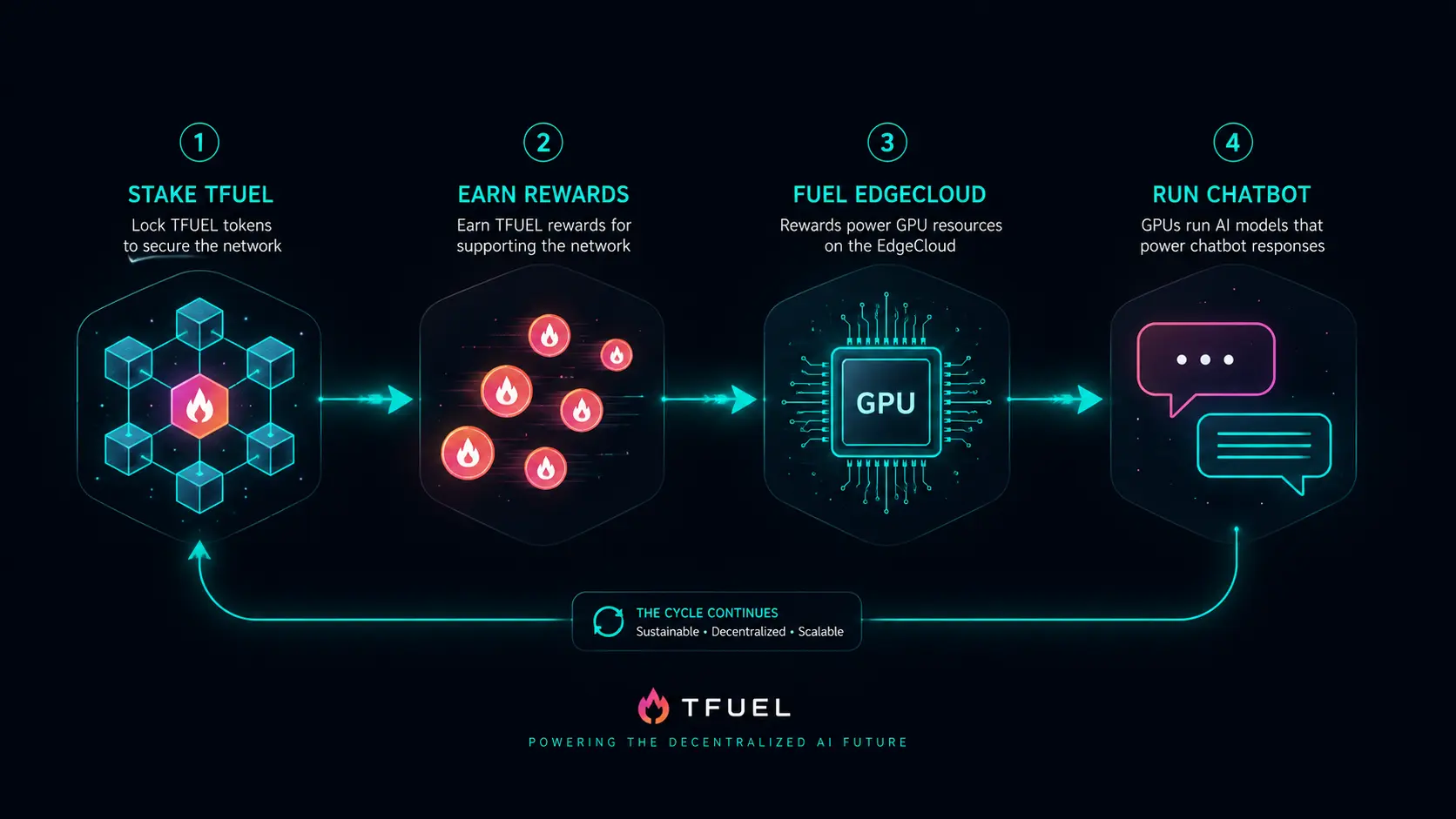
That was a few days ago. The chatbot has answered questions since then. Not millions of questions. A small number — a slow trickle of visitors trying it out. But each one of those answers cost something, and that something came out of TFUEL I earned, not TFUEL I bought.
The volume is not the point. I am one person with a small site. I am not running anything at scale. The point is that the loop closes at all. That a token I earned by helping secure the network can pay for compute that runs an actual application on the same network. That energy in the system can come back out as an answer to someone's question.
I think this is what people mean when they talk about "utility tokens," but they often mean it badly. Most things called utility tokens are just thinly disguised investment vehicles — buy them, hold them, hope they go up. TFUEL in this loop is not that. It is fuel. It is what the word actually says. Earned by participating, spent on doing, replaced by more of the same.
A few days in, the math says I am still net-positive. The TFUEL I have earned in the last week comfortably exceeds what the chatbot has consumed. If usage went up 10x I might have to top up. If it went up 100x I would definitely have to. And that is fine — at that point the chatbot would be doing real work for real numbers of people, and paying for it would be reasonable. The loop is not designed to give compute away forever. It is designed to make small operations like mine viable for as long as they stay small.
The thing I keep coming back to is not the savings. It is the threshold. Running your own AI agent, against your own knowledge base, served from your own pocket — that used to require either serious money or serious infrastructure or both. Now it requires neither. A laptop, a few days of rewards from a stake I made years ago, and a checkbox in a billing dashboard.
I am not going to overclaim what this means. It is not a revolution. It is one small loop, run by one person, on one corner of one network. But the threshold has moved. That is worth writing down.
— Jacob